

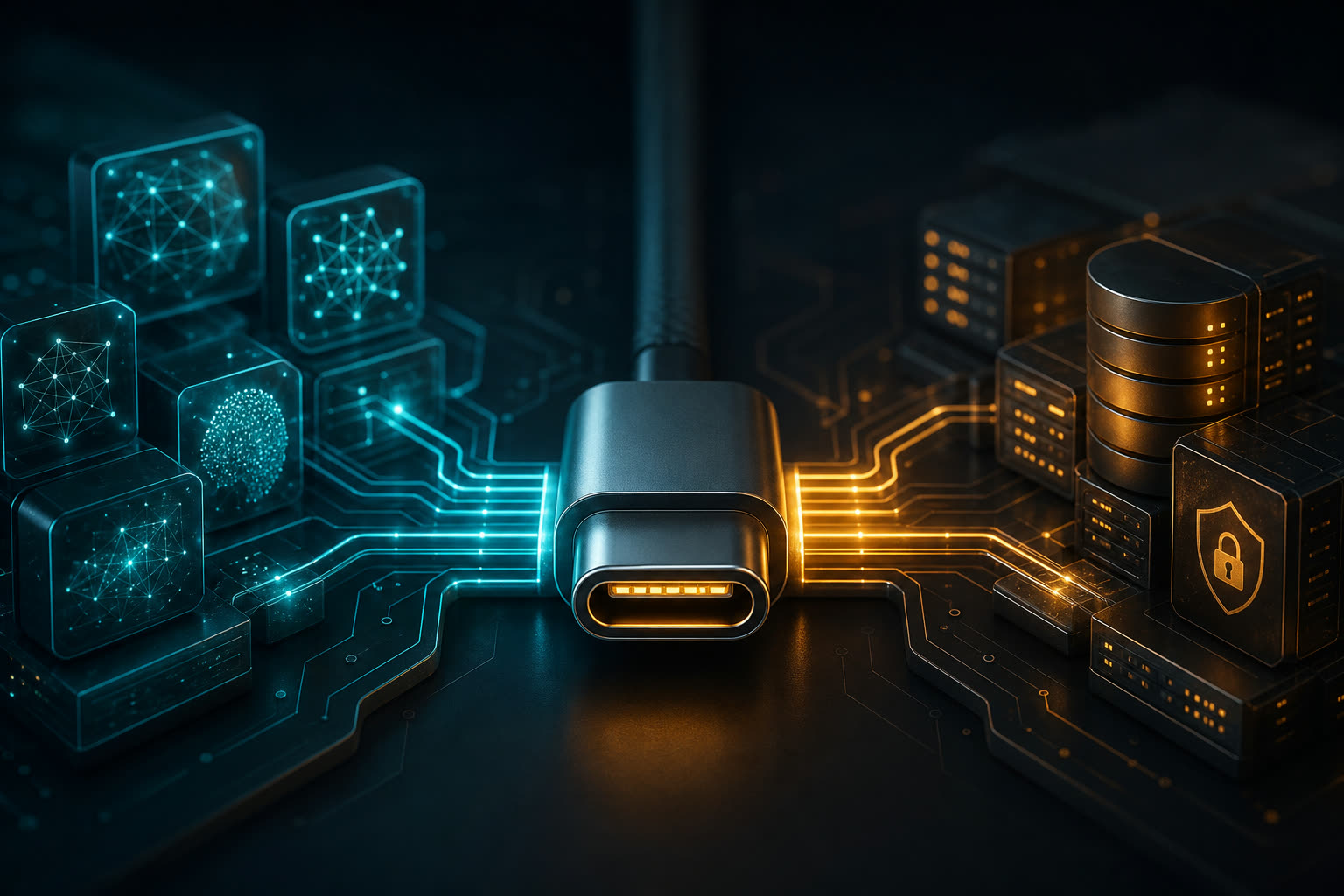
Think back to the technology landscape of the early 2010s. If you bought a new camera, phone, and e-reader, you needed three completely different charging cables. Your desk drawer was a tangled mess of proprietary wires. Then came USB-C, a universal, standardized plug that forced the entire industry into seamless compatibility.
By April 2025, the artificial intelligence industry is experiencing the exact same revolution, but for data.
For the past two years, developers have been trapped in an "API integration nightmare." If a company wanted their AI to read a Salesforce database, check a Google Drive, and pull code from GitHub, engineers had to write, update, and secure fragile custom connectors for every single tool.
Now, a widely adopted open standard has eliminated that tangled mess of code: the Model Context Protocol (MCP).
At Archwares, we engineer scalable systems that prepare our clients for the future of business. As Agentic AI and reasoning models take over the enterprise, here is why MCP has universally been crowned the "USB-C of AI," and why your digital infrastructure needs it.
What is the Model Context Protocol (MCP)?
The Model Context Protocol (MCP) is an open-source architecture that standardizes how artificial intelligence models communicate with external data sources.
Just like a physical USB-C cable has a standardized shape so it can plug into any laptop, MCP provides a standardized digital interface. On one side, you have the MCP Client (the AI model, such as Claude, DeepSeek R1, or an autonomous agent). On the other side, you have the MCP Server (your company's proprietary data, like a CRM, an internal database, or a secure file system).
Because the "shape" of the communication is standardized, any AI using MCP can instantly plug into any database using MCP. There is no need to write custom integration code from scratch. It is the ultimate plug-and-play architecture for artificial intelligence.
The Business Case: Why Enterprises Are Mandating MCP in 2025
For enterprise leaders, MCP is no longer just an emerging tech trend. It is a foundational requirement for building intelligent, scalable businesses. Adopting this standard unlocks three major operational advantages:
1. Eradicating the Cost of Custom Integrations
Before MCP, every time a new software tool was added to your tech stack, your engineering team had to burn billable hours writing and maintaining custom API bridges so the AI could access it. With MCP, our Software Development team can implement the protocol once. Instantly, your AI agents gain access to an entire ecosystem of internal tools, reducing development costs and accelerating time-to-market.
2. Bulletproof Data Security and Local Control
In highly regulated industries, you cannot simply give an AI an open-ended API key to your backend. MCP was built with a security-first mindset. When an MCP Server is set up, the enterprise retains absolute control over what the AI can see and do. Furthermore, MCP allows for local deployments. Paired with Archwares' Information Security & Compliance services, we can deploy a system where an AI securely queries your internal databases without your proprietary data ever leaving your corporate firewall.
3. Fueling the Next Generation of AI Agents
As we noted earlier this year, AI is moving from "answering questions" to "taking action" through autonomous AI Agents. But an agent is only as smart as the data it can access. MCP is the universal pipeline that feeds real-time context to these agents, allowing them to confidently execute cross-platform tasks without breaking.
Industry Applications: Seamless Connections Across Sectors
At Archwares, our AI & Machine Learning experts are utilizing the MCP standard to build cohesive, deeply integrated systems across our primary verticals:
- Healthcare: We can build an MCP Server on top of a hospital's legacy Electronic Health Record (EHR) system. An AI Agent can now securely "plug in" to fetch a patient's history, check for drug interactions, and output a summary, while strict MCP permissions ensure the AI cannot access unassigned patient files, maintaining total HIPAA compliance.
- Legal: Law firms possess massive, siloed repositories of sensitive case files. By wrapping these repositories in an MCP Server, a locally hosted reasoning model can search, cross-reference, and analyze thousands of contracts simultaneously without exposing attorney-client privilege to public cloud networks.
- Ecommerce & Retail: Instead of building custom connections for every vendor, an E-commerce platform can use MCP to instantly synchronize AI customer service agents with real-time inventory, shipping logistics, and CRM platforms, driving a frictionless Ecommerce Development strategy.
The Archwares Approach: Engineering Connected Intelligence
The shift to the Model Context Protocol proves that the true value of AI doesn't lie in the model itself, but in how well it is connected to your business data.
Led by a passionate team of technical innovators rooted in the rigorous computer science ecosystem of FAST NUCES, Archwares doesn't just build standalone apps. We architect fully integrated, future-proof digital ecosystems. We understand that your business data is your most valuable asset, and we use standards like MCP to ensure it is leveraged efficiently and securely.
Are your AI initiatives stalling because of messy, expensive data integrations? It's time to upgrade your infrastructure.
Contact Archwares today at contact@archwares.com or visit www.archwares.com to learn how we can implement the Model Context Protocol to seamlessly and securely connect your enterprise data.