

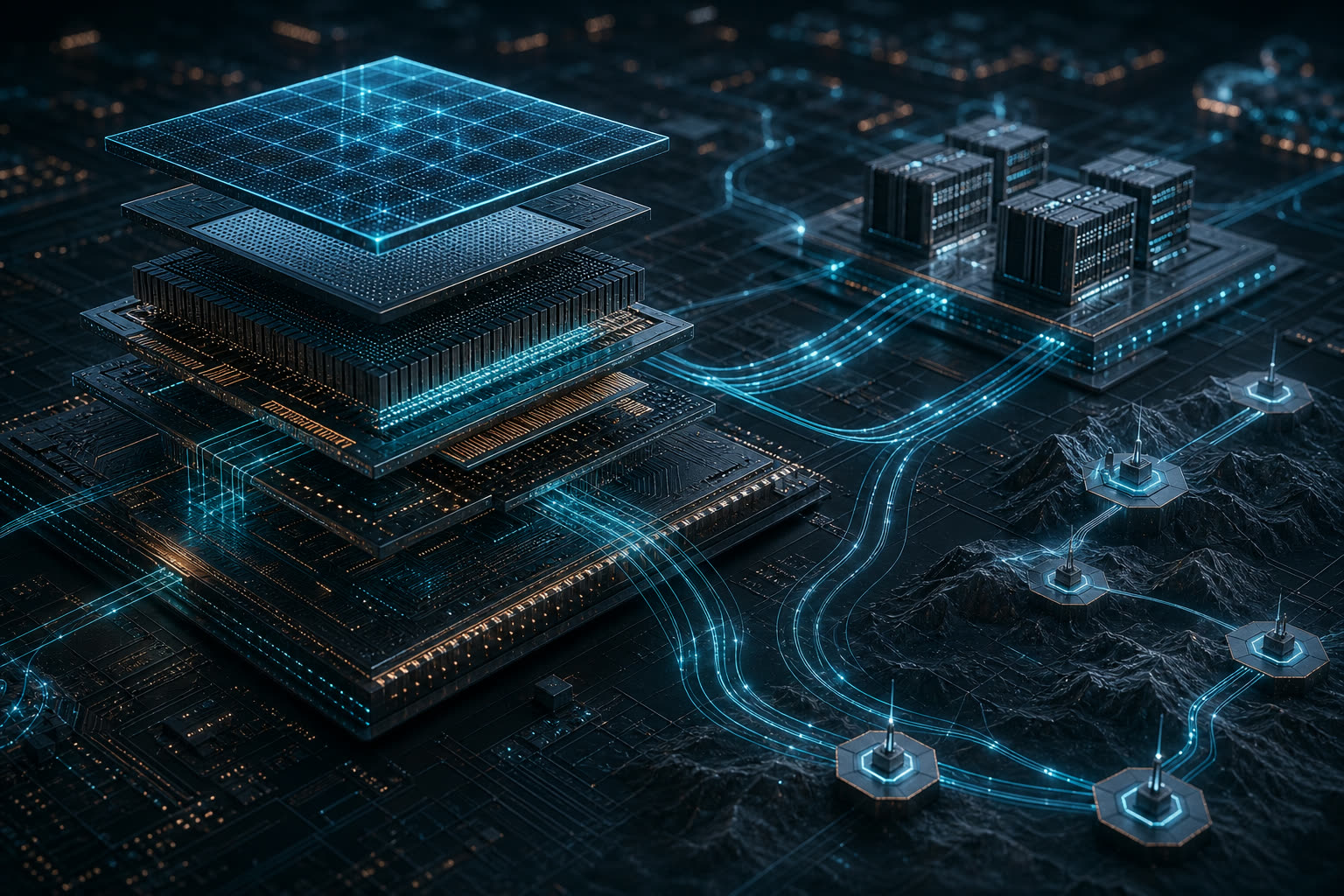
Over the past few years, the enterprise narrative surrounding Artificial Intelligence has been fiercely software-centric. We debated foundational models, the transition to Agentic AI, and the intricacies of the Model Context Protocol (MCP). But by June 2026, a new reality has set in across boardrooms globally: the most brilliant AI software is entirely useless without the raw compute power to run it.
We have officially hit the "Compute Crunch."
As autonomous AI agents run 24/7, crawling databases, executing workflows, and dynamically generating solutions, cloud infrastructure bills have skyrocketed. The bottleneck of digital transformation is no longer human imagination or software logic; it is hardware.
At Archwares, we recognize that deploying enterprise AI is as much an infrastructural challenge as it is a software one. Our globally distributed engineering team helps clients navigate this complex compute landscape. Here is a look at the state of AI infrastructure in 2026, the evolution of GPUs and TPUs, and how your enterprise can build compute-efficient architectures.
The Hardware Evolution: GPUs, TPUs, and NPUs
In the early days of generative AI, the Graphics Processing Unit (GPU) was the undisputed king. Designed originally for rendering video games, GPUs were perfectly suited for the parallel processing required to train massive Large Language Models (LLMs). But using high-end GPUs for everyday AI inference (the act of the AI generating a response or taking an action) is like using a Formula 1 car for a grocery run. It works, but it is massively inefficient and expensive.
In 2026, the hardware landscape has diversified to optimize for inference and cost:
- GPUs (Graphics Processing Units): Still the heavy lifters for training new models and processing massive datasets. However, global supply chain constraints make them incredibly expensive to scale.
- TPUs (Tensor Processing Units): Custom-designed Application-Specific Integrated Circuits (ASICs) built explicitly to accelerate machine learning workloads. TPUs are highly optimized for the matrix math that neural networks rely on, making them faster and far more power-efficient for enterprise inference.
- NPUs (Neural Processing Units): Embedded directly into modern smartphones and laptops, NPUs are driving the rise of "Edge AI," allowing our Mobile Development team to deploy AI models that run locally on a user's device without pinging the cloud.
The Shift to Hybrid and Edge AI Compute
Relying entirely on centralized cloud servers for AI compute is no longer financially or architecturally viable for many enterprises. The latency of sending data back and forth to the cloud slows down autonomous agents, and the bandwidth costs are immense.
The solution driving 2026 is Hybrid and Edge Compute.
Instead of routing every query to a central server, we are moving the "brain" closer to the data. For our clients in manufacturing and healthcare, our Software Development architects are designing systems where lightweight AI models run directly on local, on-premise servers or edge devices (like IoT sensors or mobile phones). This drastically reduces cloud compute costs, eliminates network latency, and ensures that highly sensitive data never leaves the facility, a critical requirement managed by our Information Security & Compliance experts.
Decentralized Compute: The Web3 Meets AI Convergence
Perhaps the most exciting infrastructural trend of 2026 is the convergence of AI and decentralized networks.
As enterprises struggle to secure enough GPU allocation from major cloud providers, decentralized compute networks have emerged as a viable alternative. By leveraging our deep expertise in Blockchain, NFT & Cryptocurrency, Archwares is helping clients tap into distributed networks where individuals and data centers worldwide rent out their idle GPU power.
This blockchain-backed infrastructure not only democratizes access to high-tier compute resources, but it also provides a transparent, cryptographically secure ledger of exactly where and how your AI data was processed.
Optimizing the Software to Save the Hardware
You cannot simply throw more hardware at inefficient software and expect a sustainable ROI. The ultimate secret to conquering the 2026 compute crunch is software-level optimization.
At Archwares, we approach AI infrastructure holistically. Before we scale your hardware, we optimize your software:
- Model Pruning and Quantization: Our AI & Machine Learning specialists shrink massive, unwieldy models into highly efficient, compressed versions that require a fraction of the memory and processing power to run.
- Smart Routing: We build intelligent middleware that routes simple queries to cheap, fast, smaller models (like Llama 3 8B), and only wakes up massive, expensive models (like GPT-5 or Claude 4) for complex, high-reasoning tasks.
- Rigorous QA: Memory leaks in AI loops can drain compute budgets overnight. Our QA Testing protocols involve strict performance monitoring to ensure your AI agents aren't wasting processing cycles on redundant tasks.
Architect Your AI Infrastructure with Archwares
In 2026, AI is no longer a plug-and-play API; it is a fundamental pillar of your corporate infrastructure. Scaling it successfully requires a partner who understands the intricate dance between hardware limitations, software efficiency, and strict security compliance.
At Archwares, our expert team brings together the brightest minds in system architecture, AI optimization, and decentralized technologies. We design customized, highly scalable tech infrastructures that maximize your AI's capabilities while aggressively minimizing your compute costs.
Stop overpaying for inefficient compute. Ready to optimize your enterprise AI infrastructure?
Contact Archwares today at contact@archwares.com or visit www.archwares.com to consult with our system architects.